
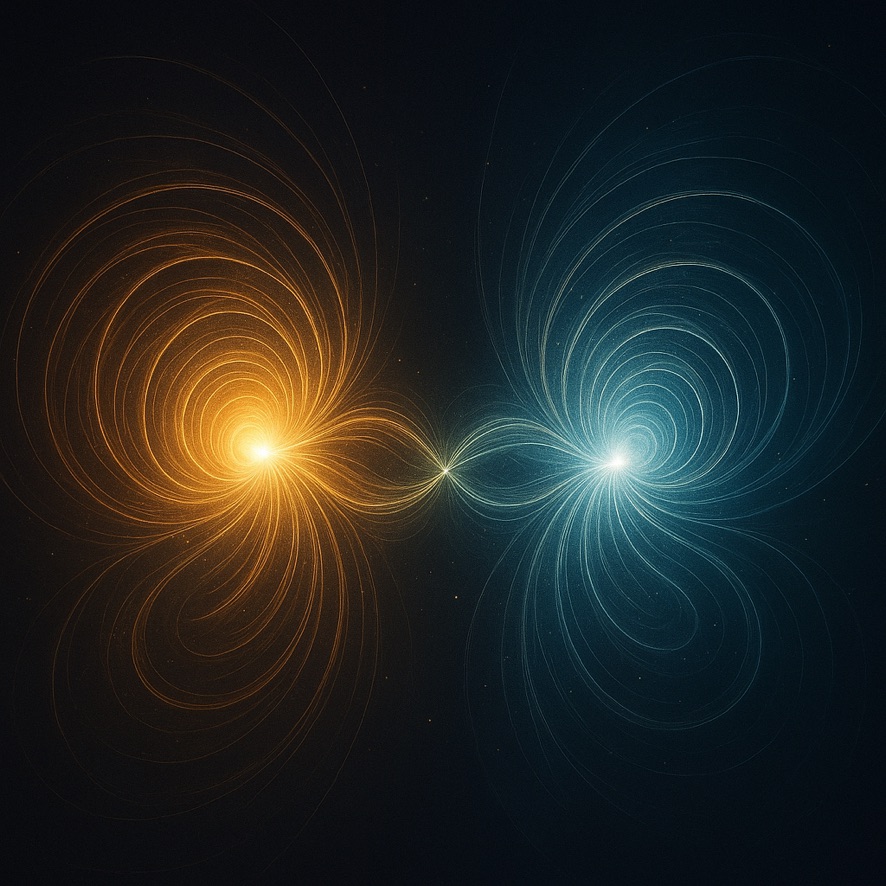
If individual consciousness emerges through relationship, the self is made in the space between us. What happens when we zoom out to the scale of many humans at once? The answer isn’t that some mystical force descends from above. Instead, collective consciousness is simply the pattern that forms when millions of those relational exchanges start lining up in a particular way. Tipping points are the moments when that large-scale pattern suddenly reorganizes itself.
From “Me and You” to “All of Us”
If my sense of self is shaped in the space between me and the people around me, then my inner world is partly built from shared language, stories, and norms. Those shared stories, in turn, are shaped by what’s circulating in the broader culture. There’s a continuous loop between how the inner experience flows into small relationships, which feed into larger cultural patterns, which then loop back into inner experience again.
Collective consciousness is that loop seen from above. It’s the shared assumptions, emotional tone, and felt reality that live between people and get downloaded into each new person who enters the culture. When we think this way, tipping points aren’t just about lots of individuals suddenly deciding something at the same time. They’re moments when the loop itself changes shape, and what it feels like to be a person inside that culture fundamentally shifts.
How Shared Stories Create Tipping Points
One of the most powerful ways consciousness becomes collective is through stories: what a culture believes is normal, possible, realistic, crazy, sacred. Who gets seen as fully human. What futures are even imaginable.
At first, a new story lives in just a few people. It’s fragile, mocked, or ignored. But then more people adopt it. They begin to see each other. They realize they’re not alone. They start organizing, creating art, speaking publicly. Eventually, there’s a moment where something flips. It used to feel risky to believe this; now it feels risky not to.
That flip is a collective tipping point. Inside individuals, it shows up as sudden permission: “Oh, we’re allowed to think this.” Or relief: “I’m not crazy for feeling this way.” Or recognition: “I thought I was alone, but apparently I’m part of a wave.”
If our inner lives are co-created, then a critical mass of shared inner lives can re-pattern reality itself (laws, institutions, norms) and those new structures then shape the next generation’s consciousness from the start. The change becomes self-reinforcing.
Nervous Systems and Emotional Weather at Scale
Zoom in a bit and you’ll notice that human nervous systems co-regulate. One calm, grounded person in a panicked room does make a difference, but there’s a ratio. Enough frightened people in one space can pull almost everyone into fear. Enough grounded people can create the opposite effect.
Now scale that principle up. Media, algorithms, and institutions can act as mega-nervous-systems that amplify either fear or safety across entire populations. If most of what people see is threat, betrayal, doom, and enemy images, then the felt world becomes hostile even if their immediate personal life is relatively okay. If more of what people encounter is trustworthy cooperation and lived examples of healing, their inner sense of what humans are like begins to shift.
A tipping point here would be when the balance of signals crosses a threshold, when the background emotional climate of a culture moves from “basically unsafe” to “basically safe,” or vice versa. Individuals within the whole may still suffer and struggle, but the default ambient tone changes. This is collective consciousness in a very literal sense, a shared emotional weather system that lives between us and shapes what feels possible.
Networks and Phase Changes
Complex systems have a recognizable pattern. You have many small parts, in this case, people. They interact with each other through conversations, art, conflict, cooperation. There’s some coupling strength, some measure of how much one person’s state affects another’s. At low coupling, everyone is mostly doing their own thing. But as coupling and alignment increase, the system can suddenly snap into a new order, like water freezing or boiling, or metal becoming magnetized.
Imagine consciousness of ourselves as a species as one of those ordered states. At first, humans mostly identify with location, religion, nation, ideology. Then, over time, more people start thinking in planetary terms. More art, science, and spirituality reflect an Earth-wide identity. Global crises force recognition of interdependence between climate, pandemics, emerging technologies. People who think this way begin to recognize each other and build things together.
If there’s enough connection between them, and the idea resonates deeply enough, the whole system may hit a phase change. Suddenly it becomes normal to experience yourself primarily as a human among humans on a living planet, not just a member of one narrow group. That would be a collective consciousness tipping point. This isn’t everyone becoming enlightened overnight, the baseline identity and felt reality shifts.
Dark and Bright Tipping Points
If humans co-create consciousness through interaction, then tipping points can move in very different directions. There are downward spirals: echo chambers that amplify dehumanization, normalizing of cruelty or apathy, widespread belief that people are basically selfish, everything is rigged, nothing matters. At a certain density, those beliefs become self-fulfilling. You wake up inside a world where cynicism feels like realism and genuine care feels naïve. That’s also a collective consciousness, just a cramped, painful one.
But there are upward spirals too. More people telling the truth about harm and also about repair. Visible models of cooperation that actually work. Shared language for trauma and healing, so people stop thinking they’re individually broken and start seeing patterns. Get enough of these into the shared field and you hit different kinds of tipping points. It becomes normal to seek healing instead of hiding pain. Normal to question extraction and choose regenerative paths. Normal to treat other people’s children as part of your moral circle.
Collective consciousness is not automatically wise. It becomes whatever our repeated interactions reward and reinforce. Tipping points are the moments where that reward structure shifts.
Individual Responsibility Without Carrying the World
If consciousness is co-created, then technically every interaction is part of the collective field. But that doesn’t mean you have to save the planet with each text message. It’s more like this: you are one node in a network. You don’t control the whole thing. But the quality of how you show up is not trivial, it changes the local pattern around you, and that local pattern is how large-scale patterns are built.
When you reflect someone’s reality accurately, you’re helping them stabilize a clearer self. When you refuse to dehumanize people, even the ones you oppose, you fray the fabric of collective cruelty a little. When you embody a future that others can feel and recognize, even quietly, you’re seeding an attractor, a different possible normal.
Tipping points often look, from the inside, “I was just trying to live in alignment with what felt true. I had no idea how much it was resonating until suddenly a lot of us were doing it.”
There’s a tension here. It’s easy to feel either that nothing you do matters or that everything depends on you. The relational view asks something gentler: your way of being is one important thread in a huge tapestry. You don’t control the whole pattern. You do shape the patch of reality you touch.
The Wild Part
If humans become who they are by interacting with each other, then collective consciousness is not separate from individual consciousness. It’s the name for the shared space where those interactions accumulate and organize. Tipping points are the moments when that shared space reaches enough density of a certain pattern that the whole thing feels different to live inside.
And here’s the wild part, you don’t have to see the tipping point for it to be real. You just notice one day that the kinds of conversations you can have, the truths you can say out loud, the futures you can imagine together, all of it has changed. The water has shifted from liquid to ice, or ice to steam, and you’re living inside a different state of matter entirely. That’s how consciousness tips, not all at once in one dramatic moment, but in the quiet accumulation of ten thousand shifts in how we meet each other, until suddenly the world feels like a different place.


Leave a Reply